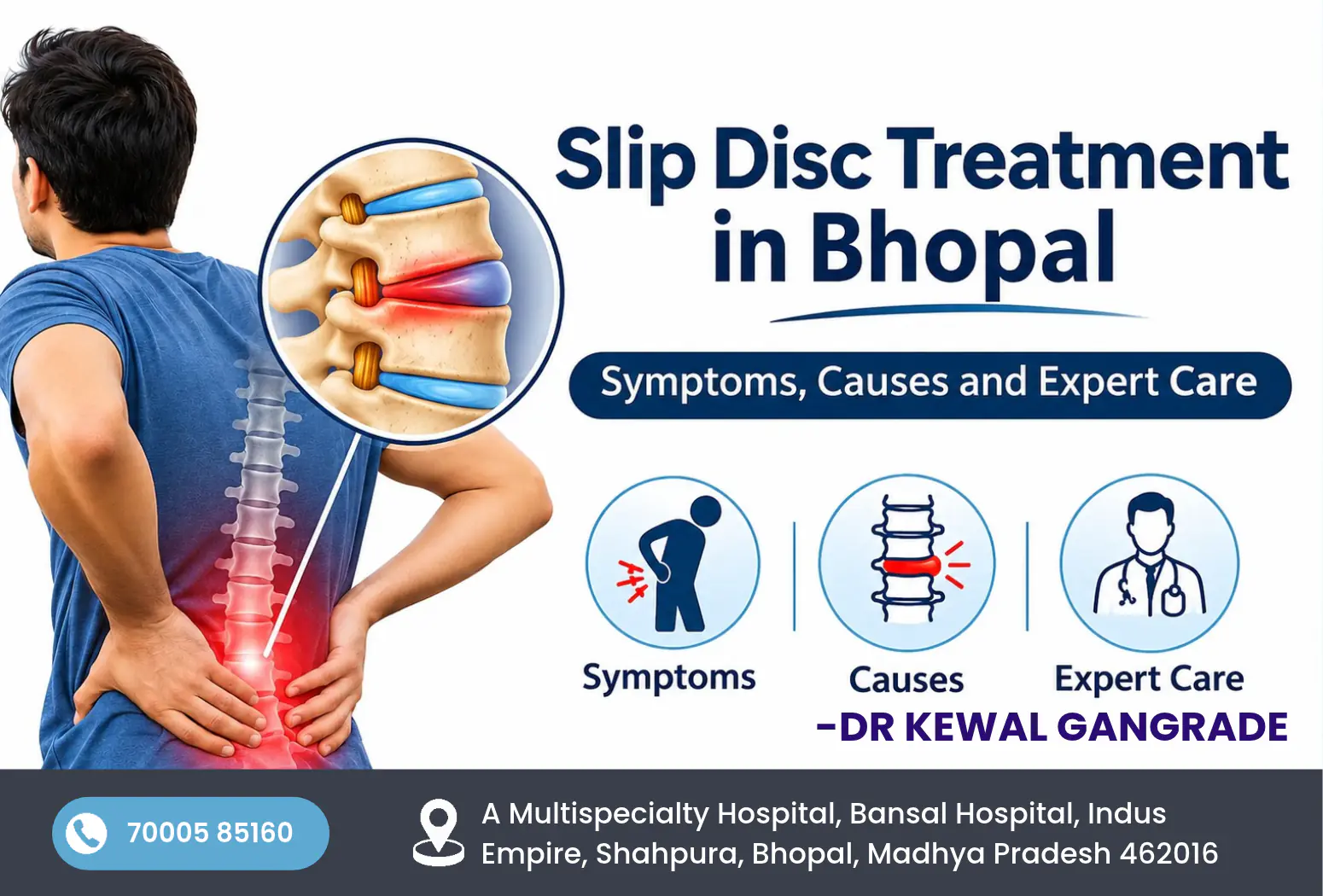
Slip disc treatment in Bhopal starts with a clear diagnosis. Dr Kewal Gangrade, an orthopedic surgeon practising in the city, helps patients understand their back and leg pain in simple, honest terms. If a sharp pain runs from your back down your leg, or neck pain spreads into your arm, you may have a slipped disc.
Most people with a slip disc get better without surgery. This guide explains the symptoms, causes, tests and treatment choices in plain language. It also tells you when to meet a slip disc doctor in Bhopal and how to choose the right orthopedic doctor in Bhopal for your spine.
What Is a Slip Disc?
A slip disc (also called a slipped, herniated or prolapsed disc) happens when the soft, jelly-like centre of a spinal disc pushes out through its tougher outer layer. The bulge can press on a nearby nerve and cause pain, numbness or weakness in the back, leg, neck or arm.
Most cases improve with rest, medicines, physiotherapy and lifestyle changes. Only a small number of patients need surgery. Good treatment focuses on relieving pain safely before any operation is considered.
Understanding Your Spine and Discs
Your spine is a stack of small bones called vertebrae. Between each pair sits a disc, which works like a cushion with a soft centre and a firm outer ring. Discs absorb shock when you walk, bend or lift, and they let your spine move smoothly.
What Does “Slipped” Really Mean?
The name is slightly misleading. The disc does not slip out of place. Its outer ring weakens or cracks, and the soft centre pushes out. If that bulge touches a spinal nerve, it causes pain.
Which Parts of the Spine Are Affected?
A slip disc can happen anywhere in the spine, but two areas are most common:
- Lower back (lumbar spine): The most common site, because it carries most of your body weight.
- Neck (cervical spine): Causes neck pain that may spread to the shoulder and arm.
It is rare in the middle of the back (thoracic spine).
Slip Disc Symptoms: Signs You Should Not Ignore
Symptoms depend on where the disc has moved and which nerve it presses on. Some people have no symptoms at all, while others have severe pain that limits daily life.
Common Symptoms of a Lower Back Slip Disc
- Dull or sharp pain in the lower back
- Pain that travels through the buttock and down one leg (often called sciatica)
- Numbness or tingling in the leg or foot
- Weakness in the leg, or difficulty lifting the foot
- Pain that worsens when you sit, cough, sneeze or bend forward
Common Symptoms of a Neck Slip Disc
- Neck pain and stiffness
- Pain spreading to the shoulder, arm or hand
- Tingling or “pins and needles” in the fingers
- Weak grip or trouble holding objects
Emergency Warning Signs
Go to a hospital immediately if you notice any of these:
- Loss of control over urine or stools
- Numbness in the groin or inner thighs
- Sudden, severe weakness in one or both legs
- Pain so intense that you cannot stand or walk
These signs may point to serious nerve compression. Quick treatment can help prevent permanent damage.
What Causes a Slip Disc?
Discs wear down slowly over time. A slip disc usually develops from a mix of age, daily habits and, sometimes, a sudden strain.
Main Causes
- Ageing: Discs dry out and lose flexibility after about 30 to 40 years of age, which makes them easier to crack.
- Improper lifting: Lifting heavy objects with a bent back, instead of bent knees, puts heavy pressure on the lower spine.
- Long hours of sitting: Desk jobs, long drives and poor posture strain the discs every day.
- Sudden injury: A fall, road accident or sports injury can damage a disc quickly.
- Repetitive movements: Jobs that involve frequent twisting, bending or heavy lifting raise the risk.
Risk Factors You Can Control
- Being overweight, which adds load to the spine
- Smoking, which reduces blood supply to the discs
- Lack of exercise and weak core muscles
- Poor sitting and sleeping posture
Risk Factors You Cannot Control
- Age
- Family history of disc or spine problems
- Being male (men aged 30 to 50 are affected more often)
How Is a Slip Disc Diagnosed?
A careful diagnosis is the first step towards the right slip disc treatment in Bhopal. A trained orthopedic doctor in Bhopal will usually follow these steps:
- Medical history: The doctor asks about your pain, daily activities, job and any past injuries.
- Physical examination: The doctor checks your posture, movement, reflexes, muscle strength and sensation.
- Leg raise test: Simple bedside tests can show whether a nerve is irritated.
- Imaging tests: An X-ray shows the bones, while an MRI scan shows the discs and nerves most clearly. A CT scan or nerve tests are advised in some cases.
Not every backache needs an MRI. Your doctor will advise a scan only when it will change your treatment. Seeing a bone doctor in Bhopal early also helps you avoid unnecessary tests and delays.
Slip Disc Treatment in Bhopal: Available Options
The right plan depends on your symptoms, scan findings, age and lifestyle. Treatment ranges from simple home care to advanced surgery, and doctors usually begin with the gentlest option, moving forward only if needed.
Non-Surgical Treatment
Most people improve with non-surgical care within a few weeks to a few months. It usually includes:
- Short-term rest: Rest for a day or two when pain is severe. Long bed rest does not help and can weaken your muscles.
- Medicines: Pain relievers, anti-inflammatory tablets and muscle relaxants can ease pain. Take them only as your doctor advises.
- Hot and cold packs: Cold reduces swelling early on, and heat relaxes tight muscles later.
- Physiotherapy: A trained therapist teaches stretches and strengthening exercises for your back, core and legs.
- Posture correction: Small changes in how you sit, stand and sleep reduce stress on the disc.
- Weight management: Losing extra weight takes pressure off your spine.
This is the foundation of back pain treatment in Bhopal for most patients, and it often brings real relief without any procedure.
Injection-Based Treatment
If pain continues despite medicines and physiotherapy, a bone specialist in Bhopal may suggest an epidural steroid injection. It places anti-inflammatory medicine close to the irritated nerve to reduce swelling, which can give you a window of relief to continue your exercises.
Injections do not repair the disc, but they can break the cycle of pain. Many patients choose this step when tablets alone are not enough.
Surgical Treatment
Surgery is considered only when:
- Pain, numbness or weakness continues after 6 to 12 weeks of proper treatment
- Leg or arm weakness is getting worse
- There is loss of bladder or bowel control (an emergency)
- Pain makes daily life or work impossible
Common surgical options include:
- Microdiscectomy: The surgeon removes only the part of the disc pressing on the nerve, through a small cut.
- Endoscopic or minimally invasive spine surgery: Very small incisions mean less tissue damage and often a shorter hospital stay.
- Laminectomy or decompression: A small part of bone is removed to create more space for the nerve.
- Spinal fusion or disc replacement: Used in more complex cases, when the spine is unstable or the disc is badly worn.
The aim of every surgery is to free the nerve, reduce pain and help you return to normal life safely. A skilled spine specialist in Bhopal will explain these options and their risks before you decide.
Recovery After Slip Disc Treatment
Recovery differs for each person, but as a general guide:
- Without surgery: Many people feel better in 4 to 8 weeks, and full recovery can take up to 3 months.
- After surgery: Most people walk within a day or two. Light work often resumes in 2 to 6 weeks, and heavy activity may take about 3 months.
Rehabilitation matters as much as the treatment itself. Regular exercise strengthens the muscles that support your spine and lowers the chance of the problem returning.
Helpful habits during recovery:
- Walk a little every day, as your doctor permits
- Avoid heavy lifting and sudden twisting
- Sleep on a firm mattress, with a pillow between your knees if you sleep on your side
- Keep following your exercise plan even after the pain settles
How to Prevent a Slip Disc
You cannot stop ageing, but these daily habits can lower your risk:
- Lift correctly: Bend your knees, keep the load close to your body and avoid twisting.
- Sit well: Keep your feet flat, your back supported and your screen at eye level.
- Take breaks: Stand up and stretch every 30 to 45 minutes if you work at a desk.
- Exercise regularly: Walking, swimming, yoga and core-strengthening exercises all help.
- Maintain a healthy weight: Every extra kilo adds stress to your lower back.
- Quit smoking: It speeds up disc wear.
- Drive with support: Use a cushion or lumbar support during long drives.
When to See a Slip Disc Doctor in Bhopal
Many people wait too long, hoping the pain will pass. A mild backache often settles on its own. However, book a consultation with a slip disc doctor in Bhopal if:
- Back or neck pain lasts more than two weeks
- Pain travels down your leg or arm
- You feel numbness, tingling or weakness
- Pain disturbs your sleep or daily work
- Medicines give only short-term relief
Early advice can stop a small problem from becoming a long-term one, and earlier treatment usually means a faster recovery. If you are unsure whether your pain is serious, a bone specialist in Bhopal can examine you and tell you whether it needs treatment or simple care at home.
How to Choose a Slip Disc Specialist in Bhopal
Your spine is delicate, so the choice of doctor matters. A good slip disc specialist in Bhopal explains your problem clearly, in words you understand. Look for:
- Proper qualifications: A registered orthopedic surgeon with formal training in bone and spine care.
- Experience: A doctor who regularly treats spine problems can tell a simple strain from a serious disc problem.
- Honest advice: Non-surgical care comes first, and surgery is recommended only when truly needed.
- Clear communication: You understand your diagnosis, your options and the expected recovery.
- Follow-up care: Good treatment includes rehabilitation and long-term guidance, not only a prescription.
Why Experience Matters
Back pain can come from muscle strain, arthritis, nerve problems or a disc issue. Treating the wrong cause wastes time and can let the real problem grow. An experienced spine specialist in Bhopal connects your symptoms, examination and scan reports to reach the correct diagnosis, and then chooses the safest treatment.
Why Choose Dr Kewal Gangrade for Slip Disc Treatment in Bhopal
Dr Kewal Gangrade is an orthopedic surgeon practising in Bhopal. He holds an MBBS and a DNB in Orthopaedics and has more than a decade of experience in bone and joint care. Patients who want an orthopedic doctor in Bhopal who looks at the whole bone and joint system can find that approach here.
His work covers spinal problems such as slipped disc, sciatica and spinal stenosis, along with fractures, joint replacement and arthroscopic (keyhole) procedures. As a bone specialist in Bhopal, he considers your complete health picture so that your plan fits your age, job and daily routine.
Patients seeking slip disc treatment in Bhopal can discuss their symptoms, scan reports and options in a clear, step-by-step consultation. He speaks English and Hindi, so you can describe your pain in the language you are most comfortable with.
What to Expect at Your Consultation
- A detailed conversation: You describe your pain, daily habits and medical history.
- A physical examination: The doctor checks your spine, movement, strength and reflexes.
- Review of reports: Bring any earlier X-rays, MRI scans or blood tests.
- A clear diagnosis: You learn what is causing your symptoms, in simple words.
- A personal treatment plan: It covers medicines, exercises, lifestyle advice and, if needed, procedures.
- A follow-up plan: You know what to do next and when to return.
Tips Before Your Visit
- Write down when the pain started and what makes it better or worse
- Carry all previous reports and prescriptions
- Make a list of the medicines you currently take
- Wear comfortable clothes that allow easy movement
Back Pain Treatment in Bhopal: Is It Always a Slip Disc?
Not every backache is a disc problem. Other common causes include muscle strain, poor posture, arthritis, a narrowed spinal canal and vitamin D deficiency. This is why a proper check-up matters before you start any treatment.
A good bone doctor in Bhopal looks at the whole picture, not just the pain. If your problem turns out to be something other than a slip disc, you still receive the right back pain treatment in Bhopal for the actual cause. Whether you visit for back pain, knee pain or an injury, the aim is the same: an accurate diagnosis first, then the simplest treatment that works.
Frequently Asked Questions (FAQs)
1. What is the best slip disc treatment in Bhopal?
The best slip disc treatment in Bhopal depends on your symptoms and scan results. Most patients recover with medicines, physiotherapy and posture correction, while injections or surgery are kept for those who do not improve. An experienced slip disc specialist in Bhopal can guide you to the right choice.
2. Can slip disc treatment in Bhopal work without surgery?
Yes. In most cases, non-surgical care works well. Rest, medicines, physiotherapy and lifestyle changes reduce swelling around the nerve, and the bulging part of the disc often shrinks over time. A slip disc doctor in Bhopal will suggest surgery only if these steps fail.
3. What symptoms does a slip disc doctor in Bhopal look for first?
A slip disc doctor in Bhopal first looks for lower back or neck pain, tingling, numbness and pain travelling down the leg or arm. If you notice these signs, seek early slip disc treatment, because timely care helps prevent long-term nerve problems.
4. How long does slip disc treatment in Bhopal take?
Recovery usually takes 4 to 12 weeks with non-surgical care. After surgery, many people return to light work within a few weeks. Your orthopedic doctor in Bhopal can give you a personal estimate based on how severe the problem is.
5. When should I see a spine specialist in Bhopal?
See a spine specialist in Bhopal if back or neck pain lasts more than two weeks, spreads to your leg or arm, or comes with numbness or weakness. Seek help at once if you lose control of urine or stools, since this needs urgent slip disc treatment.
6. Is surgery always needed for slip disc treatment in Bhopal?
No. Only a small group of patients need surgery. Most people improve with medicines, exercise and lifestyle changes, and a spine specialist in Bhopal advises surgery only for severe pain that does not settle or for worsening weakness.
7. Which doctor should I see for back pain treatment in Bhopal?
For back pain treatment in Bhopal, start with an orthopedic surgeon or a bone doctor in Bhopal. They can find out whether your pain comes from a slip disc, a muscle strain or another cause, and then begin the right slip disc treatment or other care.
8. Can exercise make a slip disc worse, and what does a bone specialist in Bhopal advise?
Wrong exercises can, but the right ones help. Heavy lifting, sudden twisting and deep forward bends may strain the disc. A bone specialist in Bhopal or a physiotherapist can teach safe exercises that support your slip disc treatment and strengthen your back.
9. What should I bring to my first visit with a slip disc specialist in Bhopal?
Bring your previous X-rays, MRI scans, blood reports and a list of your medicines, and note down your symptoms and when they started. This helps a slip disc specialist in Bhopal, or any orthopedic doctor in Bhopal, diagnose the problem faster and plan the right slip disc treatment.
10. How can I book back pain treatment in Bhopal with Dr Kewal Gangrade?
Contact the clinic through the details on this website to book an appointment with Dr Kewal Gangrade. As a bone doctor in Bhopal and bone specialist in Bhopal, he can assess your needs for back pain treatment in Bhopal and advise on the right slip disc treatment.
Conclusion: Take the First Step Towards a Healthier Back
A slip disc can feel frightening, but it is a very treatable condition. Most people recover with simple care, and those who need surgery today have more options, including minimally invasive ones. The most important step is an early, proper diagnosis.
If back, neck or leg pain is affecting your life, do not wait for it to get worse. Choose a qualified slip disc doctor in Bhopal, understand your options and start treatment on time. For slip disc treatment in Bhopal, consult Dr Kewal Gangrade, Orthopedic Surgeon, and take the first step towards a stronger spine.